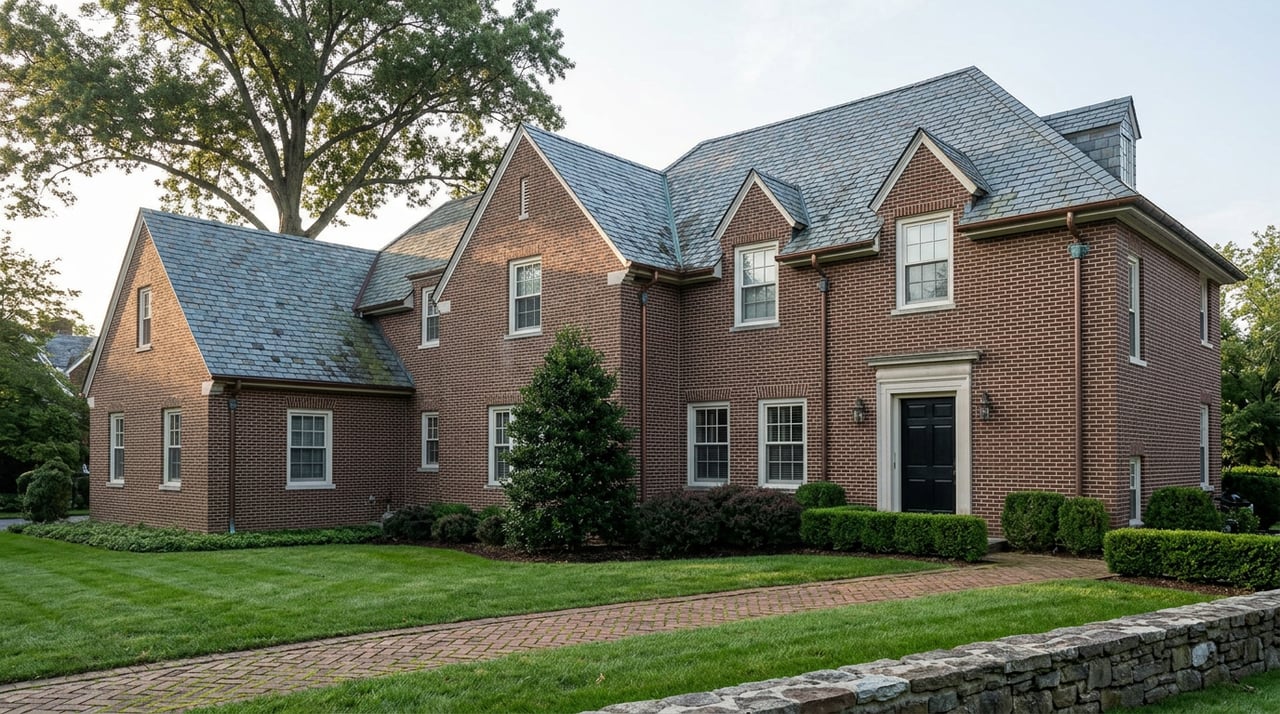
Kalorama's Median Price Fell Almost Half This Year. Here's What Actually Happened.
September 10, 2026
September 10, 2026
If you pulled up a neighborhood report for Kalorama recently, you saw a number that should have stopped you cold: the median sale price in the Sheridan-Kalorama Historic District dropped by nearly 49 percent over the twelve months ending in June 2026, landing at $961,665. In a neighborhood known for some of the most expensive real estate in Washington, that kind of drop reads like a market in free fall.
It isn't one. Nothing about Kalorama got cheaper this year. What changed is which handful of homes happened to close, in a district so small and so structurally unusual that a single sale can move the entire number.
Understanding why takes a few minutes, and it matters if you're using online median prices to size up Kalorama against Georgetown, Cleveland Park, or Dupont Circle before you've talked to anyone who actually works this market.
Ask five people where Kalorama's boundaries sit and you'll get five different answers, because Kalorama is really two historic districts that happen to share a name and a Metro-adjacent stretch of upper Northwest DC.
West of Connecticut Avenue is Sheridan-Kalorama: large, individually commissioned houses on generous lots, many of them designed for the kind of household that could afford to hire a private architect rather than buy from a builder's pattern book. This is also where you'll find the highest concentration of foreign chanceries and ambassadorial residences in the city.
East of Connecticut Avenue is Kalorama Triangle: a tighter grid of brick rowhouses and prewar apartment buildings, developed for what period accounts describe as a comfortable middle class rather than Washington's elite. Many of those apartment buildings have since converted to condos and co-ops, giving buyers here a genuinely different price point and a genuinely different transaction.
| Sheridan-Kalorama | Kalorama Triangle | |
|---|---|---|
| Location | West of Connecticut Avenue | East of Connecticut Avenue |
| Typical housing | Detached mansions on large lots, embassies, ambassadorial residences | Rowhouses and prewar apartment buildings, many converted to condos |
| Historic pattern | Sold to foreign governments in waves starting in the Great Depression | Built for middle-class households from the 1890s through the 1920s |
| What moves the median | One mansion sale can swing the whole period | Ordinary turnover across many smaller units |
A renovated one-bedroom condo near the Triangle and a seven-bedroom Beaux-Arts mansion west of Connecticut Avenue are not the same asset class, but public data sources often report them under one blended Kalorama number. That's the first reason the median is a poor guide here. It isn't the last.
The bigger issue is supply, and it has been building for nearly a century. Starting in the Great Depression, financially stretched owners of Sheridan-Kalorama's largest houses began selling to foreign governments looking for representative space close to Embassy Row. That pattern continued for decades, and it didn't stop when the housing market recovered. Some of Washington's most recognizable private addresses left the residential market permanently and never came back.
A few examples make the pattern concrete:
None of these will ever generate a comparable sale again. Every one of them is a home that, in an ordinary DC neighborhood, would eventually cycle back onto the market, get renovated, get flipped, get inherited and sold. In Sheridan-Kalorama, a meaningful share of the largest housing stock simply exited the private market and stayed out.
That leaves a much smaller pool of "comparable" mansions available to sell in any given year than you'd expect from a neighborhood with this address recognition. When the pool is that small, the composition of who happens to sell in a given twelve-month window can swing the median in ways that have nothing to do with what buyers are actually willing to pay.
This is the statistical mechanism behind that 48.8 percent figure. A median only tells you something useful when it's drawn from a large, stable sample. In a district where the annual sales count is small to begin with, and where the properties that do sell range from a condo in a converted apartment building to a multimillion-dollar detached mansion, the year-over-year comparison isn't measuring price movement. It's measuring which properties happened to close.
If the prior twelve-month period included one or two large single-family sales and the current period happened to include more condo and rowhouse turnover, the median will drop sharply even if every individual property sold at or above what a similar property fetched a year earlier. Nothing about this is unique to Kalorama in principle. It's the same reason a small town's median home price can jump 30 percent because one large farmhouse sold. But Kalorama's supply structure makes this effect unusually persistent, because so much of what would otherwise be comparable inventory has been permanently removed from the pool.
In May 2026, separately published market data placed Kalorama's overall median list price near $2.27 million, at roughly $803 per square foot, with homes spending a median of 41 days on market. That figure sits closer to what most buyers actually experience when they're evaluating a specific listing, and it's a useful reminder that the sale-price median and the list-price median aren't answering the same question.
There's one more wrinkle. Agents who work this pocket of Northwest DC consistently describe a level of discreet, off-market activity here that's unusual even by DC luxury standards. Long-time owners downsizing, estate sales, and embassy-adjacent transactions are more likely to move through private networks than through a public listing. That means the visible inventory you see on any portal is understating true supply and, by extension, understating the real transaction volume behind any median you're looking at.
"People would hire America's best and brightest architects of the time to build their house," one longtime Kalorama resident and agent said, describing the neighborhood in its early 20th-century building boom.
That architectural pedigree is real, and it's part of why buyers still pay a premium here despite a data picture that's genuinely harder to read than in most DC neighborhoods.
If Kalorama is on your list alongside Georgetown, Cleveland Park, or Dupont Circle, treat the blended median as a starting point, not an answer.
Ask for price per square foot broken out by subarea and property type, not a single Kalorama-wide number. A Sheridan-Kalorama mansion and a Kalorama Triangle condo will tell you almost nothing about each other's pricing.
Ask how many comparable sales actually informed whatever median you're looking at. If the answer is a handful, the number is fragile by design, not evidence of a cooling or overheating market.
Ask your agent what's moving privately. In a neighborhood where off-market activity is this common, the property that fits what you're looking for may never appear in a public search at all.
Budget time for financing and inspection. Jumbo mortgages and cash purchases are common here, unique properties can complicate appraisals, and older prewar construction deserves a thorough inspection from someone who understands historic building systems before you commit. If you're eyeing a home in either historic district, know that exterior changes typically require review from DC's Historic Preservation Review Board, which can add time to your renovation timeline even after closing.
Does Kalorama's median price ever describe a "typical" home? Rarely. The neighborhood mixes embassy-scale mansions with condos and rowhouses, and the annual sales count is small enough that one or two transactions can dominate the average in any given period.
Why are so many Kalorama sales never listed publicly? Long-time owners, estate transitions, and embassy-related purchases move through private networks more often here than in most DC neighborhoods, which means public portals tend to understate real inventory and activity.
Is Kalorama Triangle a more affordable way into the neighborhood? Generally yes. Kalorama Triangle's rowhouses and converted apartment buildings sit east of Connecticut Avenue and price differently than the detached mansions and embassy-adjacent homes west of it in Sheridan-Kalorama.
Does living near an embassy affect what I can do with my own property? It doesn't restrict a private residential sale, but many Kalorama blocks fall within a historic district, so exterior renovations will likely need review from DC's Historic Preservation Review Board regardless of what's next door.
Kalorama rewards buyers who read past the headline number, and that's exactly the kind of neighborhood-specific reading the Robert & Tyler Team does for every client comparing DC's close-in neighborhoods. If you're weighing Kalorama against another Northwest DC address, reach out and we'll walk through what the current data actually means for your search.
Stay up to date on the latest real estate trends.
A personalized strategy, proven marketing expertise, and a commitment to exceptional client service drive every transaction. With over $1.3 billion in career sales, the Robert & Tyler Team combines innovative marketing, skilled negotiation, and deep local market knowledge to help buyers and sellers achieve outstanding results throughout the Washington, DC region.
THE ROBERT & TYLER TEAM
Robert Crawford
[email protected] | 202.841.6170
Tyler Jeffrey
[email protected] | 202.746.2319
Abby Schulten
[email protected] | 203.293.3379
Elizabeth Mandle
[email protected] | 864.704.2965
Mike Favazzo
[email protected] | 970.710.1246
ADDRESS 5101 Wisconsin Avenue NW, Suite 100 Washington, DC 20016