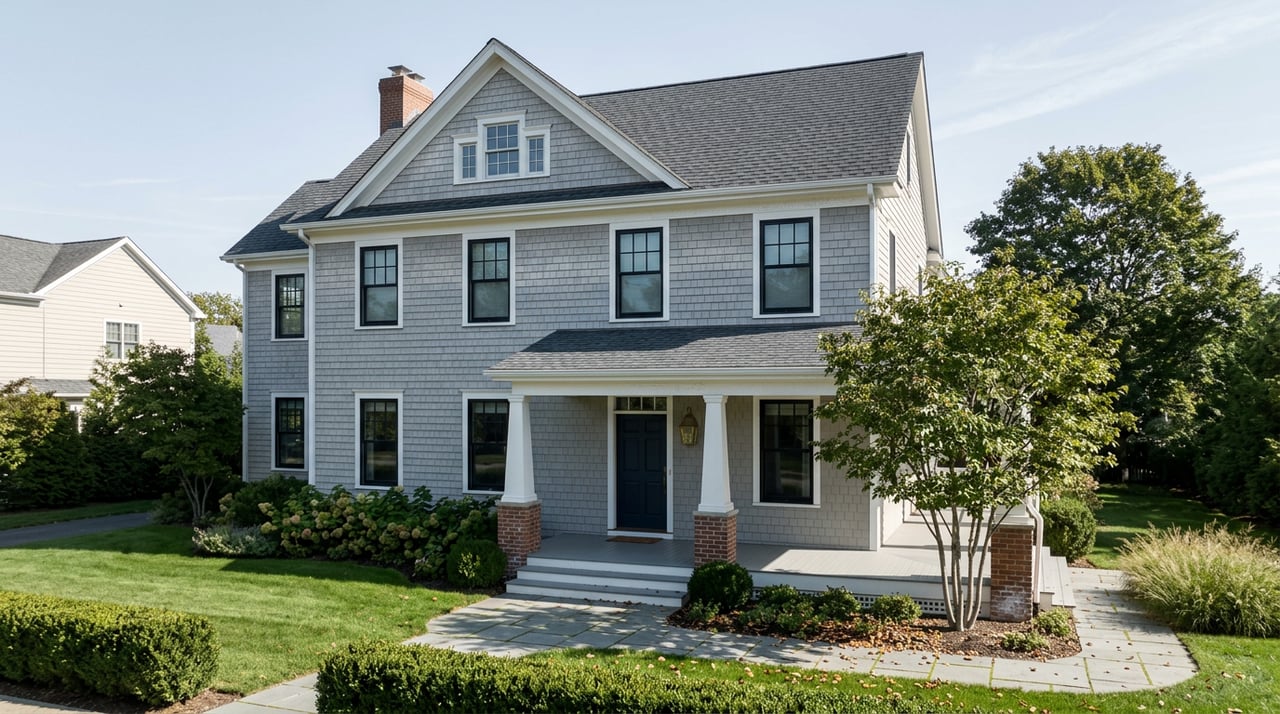
Arlington's Missing Middle Was Supposed to Remake the Map. Here's What Actually Got Built.
September 3, 2026
September 3, 2026
A builder named Wilson broke ground on a duplex in Arlington's Claremont neighborhood in 2024, confident in a permit the county had approved under its new zoning rules. Then a circuit court judge voided that permit along with every other Expanded Housing Option approval on the books. Wilson was left holding a half-finished structure he could neither complete nor sell, paying $25,000 a month in interest while the legal ground shifted under him. He sold personal property he had owned since he was twenty. He put a second mortgage on his own house. That is the real texture of Arlington's missing middle story right now, and it has almost nothing to do with density.
If you are comparing older, single-family blocks in Arlington against newer construction or against neighborhoods across the river in DC, you have probably absorbed the headline version of this story: Arlington ended single-family zoning in 2023, and duplexes, triplexes, and six-unit buildings are quietly replacing the county's postwar housing stock one lot at a time. That version is not wrong, but it is not the risk that should actually shape how you evaluate a specific street or a specific lot. The real story is a legal one, and it changes what due diligence looks like for anyone buying, selling, or holding property near an EHO-eligible parcel.
The Expanded Housing Option ordinance, commonly called Missing Middle, has been law, then not law, then law again, over the course of three years:
| Date | What happened |
|---|---|
| March 2023 | Arlington County Board unanimously approves EHO, allowing up to six units on lots previously zoned for single-family homes |
| September 2024 | Circuit Court Judge David Schell voids the ordinance, ruling the county failed to follow proper procedure and did not adequately study local impacts |
| June 2025 | Virginia Court of Appeals reverses that decision on a procedural technicality, finding that developers with existing EHO permits should have been included in the original lawsuit |
| April 8, 2026 | Virginia Supreme Court hears oral arguments on whether to take up the case |
| May 19, 2026 | Virginia Supreme Court agrees to review the case, though only on the procedural question, not on whether EHO itself is legally valid |
As of this writing, EHO is the law of the land in Arlington and the county continues to process applications. But everyone involved, including the county itself, describes this as provisional. Arlington County's own EHO page tells applicants plainly that the underlying merits of the case are still unresolved. Legal tracking of the case lays out two paths from here: if the homeowner-plaintiffs prevail at the Supreme Court, the September 2024 ruling voiding EHO snaps back into effect immediately. If the county prevails, the case returns to trial court for a full hearing on the merits with every party, including EHO permit holders, at the table this time.
That is not a footnote. That is the actual condition of the market.
Here is the gap that matters most for anyone pricing risk into a neighborhood comparison. As of September 2025, more than two years after EHO took effect, only two new-construction EHO buildings had actually been completed in all of Arlington County: a duplex in North Highlands and a duplex in Claremont. Meanwhile the county's permit dashboard listed around 59 approved EHO projects as of the Virginia Supreme Court's April 2026 oral arguments, with nine more added in the months following the Court of Appeals reversal.
That is a wide gap between approved and built, and the legal uncertainty is the reason for it. Some developers who had already invested in EHO projects pivoted their plans back to single-family construction rather than sit through another possible void-and-reinstate cycle. Custom homebuilder Classic Cottages, which typically builds up to 40 homes a year in the county, described the whiplash of being denied a right to intervene in the lawsuit while somehow not being considered a necessary party to it.
The scale of what has actually been built is also smaller than the headlines suggest. County data on the first year of EHO permits shows the average approved EHO home runs about 1,646 square feet with three bedrooms. In that same period, the county issued 80 single-family detached permits averaging 5,259 square feet with five bedrooms. Missing Middle housing, where it has actually appeared, is modest infill, not a wave of replacement construction sweeping entire blocks.
The lots where EHO activity has clustered are specific, not countywide. Halls Hill, one of Arlington's historically Black neighborhoods, has seen some of the most visible teardown-to-duplex activity, with critics pointing to new units listing in the range of $1.4 million to $1.8 million per side. Claremont, North Highlands, and Ballston have each had at least one completed or under-construction project. Aurora Hills had a permit approved for a six-unit building on 17th Street South before the litigation put it on hold.
If your search has you looking at a lot in one of these specific pockets, the zoning conversation is genuinely relevant to your due diligence. If you are looking in Arlington Forest, Lyon Village, or the Dominion Hills corridor, the missing middle story is largely a legal abstraction rather than something reshaping your block.
For a buyer or seller dealing with a property that has an EHO permit attached, or a lot that could plausibly qualify for one, the practical question is not "will this neighborhood get denser." It is "what happens to this specific permit if the Virginia Supreme Court rules against the county." Some developers have started petitioning the Circuit Court directly for vested rights, an attempt to protect a project from being unwound regardless of how the larger case resolves. That is a sign of how seriously builders are taking the possibility that the ordinance gets struck down again.
For a home search, this translates into a short, specific checklist rather than a vague sense of unease. If a lot near you has an EHO application in progress, Arlington County's permit tracker shows its current status, and it is worth checking before you write an offer near it or price a sale around it. A permit marked approved today has already flipped status once in this county's recent history.
While the litigation has consumed attention, the ordinary forces of supply and price tier have kept doing what they always do in Arlington. In July 2026, the county's median sales price stood at $823,000, with year-over-year sales down about 5 percent to 227 properties, according to Northern Virginia Association of Realtors data reported by ARLnow. Looking back at full-year 2025, condo prices fell roughly 7.4 percent, the weakest-performing segment countywide, while single-family detached homes rose nearly 2 percent, the strongest-performing segment. North Arlington neighborhoods including Lyon Village, Country Club Hills, and the Dominion Hills corridor posted some of that year's strongest price gains.
That pattern runs opposite to what a reader would expect if missing middle zoning were actually flooding the market with new supply. The neighborhoods that gained the most in 2025 are the same legacy single-family pockets that have seen little to no EHO construction. The segment that lost value is condos, a category EHO does not touch. The real driver of Arlington's price story remains what it has always been: tight inventory in established, transit-accessible neighborhoods, not a zoning change still tied up in court.
If you are weighing an older single-family block against a newer one, or weighing Arlington against a close-in DC neighborhood, treat the missing middle headlines as background rather than as a pricing input for most of the county. The exception is a narrow one: if you are specifically evaluating a lot in Halls Hill, Claremont, North Highlands, Ballston, or Aurora Hills, or if a property you are considering already has an EHO application attached, that is worth a direct conversation about permit status and what a Supreme Court ruling could mean for it. Everywhere else, the fundamentals driving price in 2026 look like the fundamentals that have always driven Arlington price: proximity to Metro, school-adjacent single-family stock, and how little of it comes to market in a given month.
Is missing middle zoning still legal in Arlington right now? Yes, as of August 2026. The Expanded Housing Option ordinance is in effect and the county continues to accept and process applications, but the underlying legal challenge is still pending before the Virginia Supreme Court.
Could a duplex or six-plex still go up next to my home? It is possible on an eligible lot, but the actual pace of new construction has been slow. Only two new EHO buildings had been completed as of September 2025 despite dozens of approved permits, largely because of the ongoing litigation.
How do I find out if a specific Arlington lot has an EHO permit or application attached? Arlington County maintains a public EHO permit tracker that is updated weekly, along with a property search tool that shows zoning, lot size, and permit history for individual addresses.
Zoning headlines move fast. What actually gets built moves much slower, and the difference between the two is exactly where good local guidance earns its keep. If you are weighing an Arlington block against another close-in neighborhood, or trying to understand what a specific lot's permit history actually means for your offer, the Robert & Tyler Team can walk through the current status with you before you write anything down.
Stay up to date on the latest real estate trends.


A personalized strategy, proven marketing expertise, and a commitment to exceptional client service drive every transaction. With over $1.3 billion in career sales, the Robert & Tyler Team combines innovative marketing, skilled negotiation, and deep local market knowledge to help buyers and sellers achieve outstanding results throughout the Washington, DC region.
THE ROBERT & TYLER TEAM
Robert Crawford
[email protected] | 202.841.6170
Tyler Jeffrey
[email protected] | 202.746.2319
Abby Schulten
[email protected] | 203.293.3379
Elizabeth Mandle
[email protected] | 864.704.2965
Mike Favazzo
[email protected] | 970.710.1246
ADDRESS 5101 Wisconsin Avenue NW, Suite 100 Washington, DC 20016