The Bethesda Condo Paradox: Why Bigger Costs More Per Square Foot Downtown
July 9, 2026
July 9, 2026
Two buyers in downtown Bethesda write offers on the same afternoon in June 2026. One puts $1.45 million on a four-bedroom Colonial with a driveway near Bradley Boulevard. The other puts $1.45 million on a two-bedroom condo at The Lauren, half a block from the Red Line.
On paper, they paid the same price. On a per-square-foot basis, the condo buyer paid nearly twice as much. That gap is not an accident of one deal. It is the defining feature of the downtown Bethesda condo market, and it points to a supply problem that the current construction pipeline is unlikely to solve.
In most housing markets, price per square foot falls as units get larger. Downtown Bethesda does the opposite. New and near-new condo product in the core trades in an $800 to $1,500 per square foot range, with the top of that band reserved for the largest floor plans. The Residences at The Lauren once offered a 7,000 square foot penthouse at $10 million, a figure that would have set a DC-area MLS record.
Compare that to the detached market. Bethesda's overall median sale price landed at $1.3 million over the three months ending May 2026, with a median of roughly $472 per square foot, according to Redfin's May 2026 market update. Movoto's June 2026 snapshot showed a $1.448 million median across 437 sales and 39 days on market. In other words, the median detached home in Bethesda sells at roughly one-third the per-foot price of a new downtown three-bedroom condo.
That is the paradox. The land under the condo is not scarcer than the land under the Colonial. The interiors are not meaningfully more expensive to build. So why does the condo cost more per foot as it gets bigger?
The answer is scarcity inside a specific slice of the market. Downtown Bethesda has built a lot of studios and one-bedrooms over the last decade. It has built very few three- and four-bedroom condos with enough square footage to function as a full-time primary residence for a household leaving a detached home.
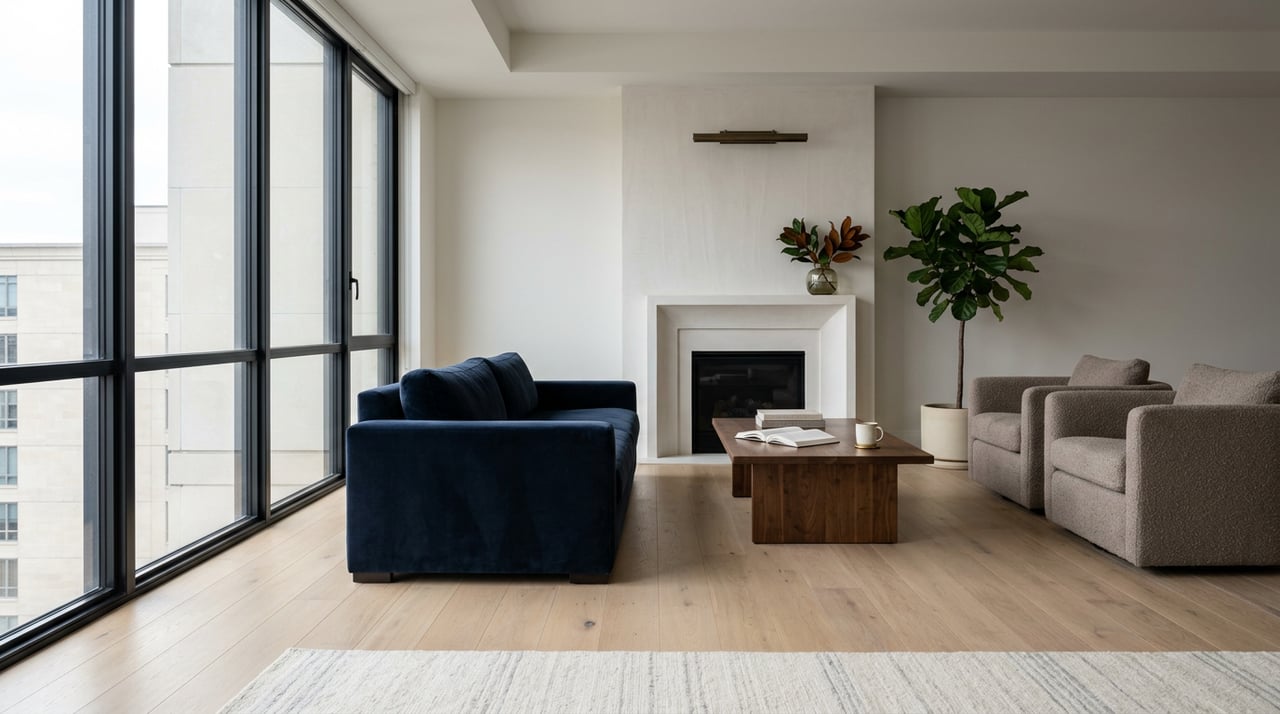
The Lauren, a 34-residence boutique building on Woodmont Avenue, is one of the few sources of that product. Its two-, three-, and four-bedroom layouts run from 1,400 to more than 4,000 square feet, and prices climb from about $1 million to north of $5 million. Hampden Row, the 55-unit Toll Brothers building completed in 2017, plays a similar role at the upper end, with typical pricing between $1.2 million and $3 million-plus and a rooftop program aimed squarely at the empty-nester buyer. Edgemoor Condominiums and The Darcy round out the short list of buildings where a household can plausibly downsize from a detached home without giving up a real second bedroom, a study, or storage.
When a small number of buildings hold most of the inventory a specific buyer needs, the marginal square foot inside those buildings gets bid up. That is the mechanism. Large condos in downtown Bethesda are not priced against smaller condos. They are priced against detached homes their buyers are choosing to leave, and the buyers moving in are usually swapping equity from a $2 million to $3 million house for the walkability of Bethesda Row and the Red Line.
If you look at the projects currently under construction or on the boards, the shortage does not resolve. The vast majority of new units are rental apartments or small-format condos. A partial roll of what has been approved or filed in and around downtown, drawn from UrbanTurf's Bethesda development coverage and the Bethesda Urban Partnership project tracker:
Two things stand out. First, the count of new rental units dwarfs the count of new for-sale condo units. Second, of the for-sale condo units that are moving forward, the floor plans skew toward the one- and two-bedroom formats the market has already overbuilt. There is no announced tower whose thesis is "large owner-occupied residences for households selling detached homes in the $2M-plus range." Rezoning in Woodmont Triangle has raised height and density, but the economic pull on developers is toward smaller, more numerous units, not fewer, larger ones.
Add the affordable pipeline, and the picture is the same. Montgomery County broke ground on NoBE II at Rockville Pike and Nicholson Lane on March 30, 2026, a 268-unit fully affordable building expected to deliver in summer 2028, per Bethesda Magazine's coverage. The unit mix runs heavily to studios and one-bedrooms, with only seven three-bedroom and seven four-bedroom apartments in the whole building. Even the housing built for a very different income tier reinforces the same imbalance: a lot of small, very little large.
For a family looking at $1.4 to $1.6 million in Bethesda, the two options are not comparable in the way they look on a listing portal.
At that price in the detached market, a buyer is typically looking at a four-bedroom, three-bath house between 2,400 and 3,000 finished square feet on a modest lot inside 20814 or 20817, often with a kitchen or bath renovation still pending. The per-foot cost sits near that $472 median. At the same price downtown, the buyer is looking at a two-bedroom condo of roughly 1,300 to 1,600 square feet in a full-service building with concierge, parking, and access to Bethesda Row on foot.
The move-up buyer who reads only the median is comparing prices. The move-up buyer who reads the per-foot figure is comparing products. The condo is not overpriced against the house. It is a different asset, priced against a different pool of buyers, most of whom are not choosing between the two.
The friction in the transaction shows up on the sell side. A family listing a detached home at $1.45 million in Bethesda is competing against 437 other June sales and a 39-day average time on market, based on Movoto's June 2026 figures. Sale-to-list ratios have settled into a 98 to 101 percent band, according to reporting from Saenger Group's March 2026 Bethesda update. That is a market where preparation and pricing matter more than urgency. The seller who assumes 2021 comps will hold gets a long DOM and a price reduction. The seller who prices to the current per-foot benchmark, then presents well, still clears in three to four weeks.
The empty-nester story is where the paradox does the most damage to a plan.
A household selling a $2.5 million detached home in Bethesda expects to reinvest a portion of the proceeds into a downtown condo and bank the rest. If the target condo is a 2,200 square foot three-bedroom at Hampden Row or The Lauren, the reinvestment number is often $2 million or more, not the $1.2 million the seller had penciled in from browsing one-bedroom comps. The math still works. It just works differently than the portal previews suggest.
There are two practical implications. First, the sale side of the transaction has to be timed and priced with the actual condo target in hand, not against a generic "downsize to a condo" assumption. Second, the specific building matters more than the specific street. Inventory in the three-bedroom tier at the top four or five buildings turns over slowly, and off-market activity is a meaningful share of what actually trades. A buyer who insists on an active MLS listing may wait a year for a floor plan that a well-connected agent could have surfaced quietly in a month.
Will the Purple Line change downtown Bethesda's condo economics? The 16-mile light rail line, running from Bethesda to New Carrollton with 21 stops, is a demand story, not a supply story. It brings more buyers to the Red Line terminus. It does not add three-bedroom condos to the buildings that already have them.
Is downtown Bethesda overbuilt? In the rental and small-condo segment, supply is plentiful and getting more plentiful. In the large owner-occupied condo segment, supply is thin and the pipeline does not fix it. The word "overbuilt" only applies to one half of the market.
What about new construction detached homes? Teardown-and-rebuild activity continues across 20814, 20816, and 20817, but the finished product typically prices well above $2.5 million and does not compete with downtown condos on a per-foot basis or a lifestyle basis. It is a third market, not a substitute for either of the first two.
The Bethesda market rewards buyers and sellers who understand which of these submarkets they are actually operating in. If you are weighing a move up, a rightsize, or a first purchase in the area, the Robert & Tyler Team can walk you through what your price point buys across each format, and where the current pipeline changes the calculus. Contact us to start the conversation.
Stay up to date on the latest real estate trends.
A personalized strategy, proven marketing expertise, and a commitment to exceptional client service drive every transaction. With over $1.3 billion in career sales, the Robert & Tyler Team combines innovative marketing, skilled negotiation, and deep local market knowledge to help buyers and sellers achieve outstanding results throughout the Washington, DC region.
THE ROBERT & TYLER TEAM
Robert Crawford
[email protected] | 202.841.6170
Tyler Jeffrey
[email protected] | 202.746.2319
Abby Schulten
[email protected] | 203.293.3379
Elizabeth Mandle
[email protected] | 864.704.2965
Mike Favazzo
[email protected] | 970.710.1246
ADDRESS 5101 Wisconsin Avenue NW, Suite 100 Washington, DC 20016