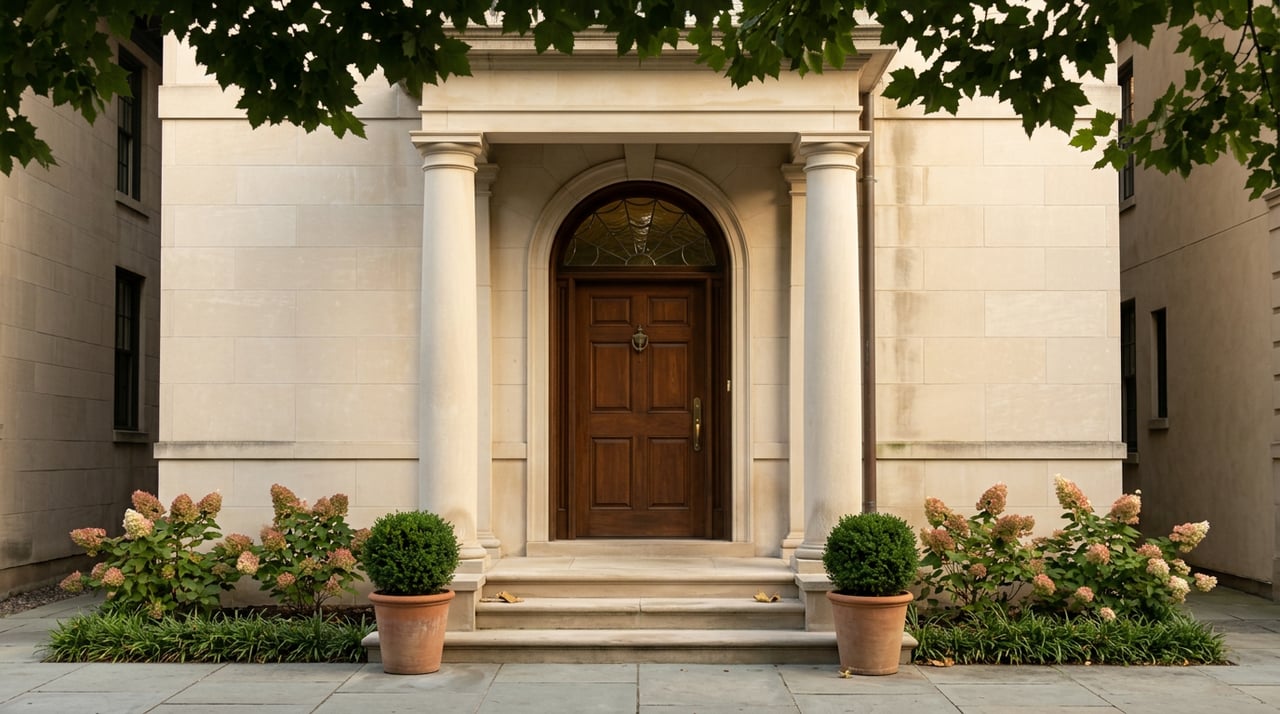
August in Kalorama: How Mitchell Park's Film in the Field Anchors the Neighborhood's Quietest Month
August 6, 2026
August 6, 2026
The last full week of August in Kalorama reads, from the sidewalk, like nothing is happening. Embassies have shed their spring reception schedules. The Woodrow Wilson House gets its afternoon tour groups and closes at five. Mitchell Park's paths are empty at noon. On Massachusetts Avenue, the ambassadors' flags hang without much traffic underneath them.
Then Thursday night arrives, and roughly half the neighborhood walks to the same lawn.
The Friends of Mitchell Park run a summer series called Film in the Field. It is a small, resident-scale event: a screen, a lawn between S Street and 23rd, a sunset start time, and light refreshments from a nonprofit that has done this long enough to stop advertising it. The 2026 calendar is short and deliberate:
The August 20 screening is the one that matters if you live here. It is the last summer-length film before the September closer, which starts thirty minutes earlier because the sun has moved. The series is sponsored by three TTR Sotheby's International Realty partners, which is worth naming only because it explains how a two-acre park hosts a free film program without a city grant.
Four dates over four months is not much programming. That is the point of the observation that follows.
Kalorama does not have a commercial spine. There is no equivalent to Wisconsin Avenue in Georgetown, King Street in Old Town, or the 14th Street corridor that reorganized Logan Circle this summer. The street grid was deliberately exempted from the District's gridded plan when the neighborhood was carved out of Joel Barlow's early-1800s estate, and the curved, one-way lanes that resulted have never held a row of storefronts. What Kalorama has instead is roughly 2,200 residents, more than fifty embassies and ambassadorial residences, and two parks.
That absence is why the movie night carries so much weight. In a neighborhood that runs on foot traffic between private front doors, a public gathering with a fixed start time functions as the closest thing to a town square. You see the same people you pass on morning walks, but with wine and a blanket, which is a different social register. The neighborhood is small enough that one screening a month is enough infrastructure.
Compare it to the way summer reorganizes other close-in neighborhoods and the contrast sharpens. Dupont's summer has been rerouted by the Connecticut Avenue deckover. Cleveland Park's has been rebuilt around the Promenade block. Kalorama's has not moved at all. Its August looks essentially the way its August looked a decade ago, because the pieces that carry it are not commercial and were not built to churn.
For a resident planning the last two weekends of the month, the useful geography is short:
Five stops, none of which sell you anything. The neighborhood's daytime rhythm is essentially a private one dressed in public clothes.
The commercial spine Kalorama does not have starts one block east, along Columbia Road at the edge of Adams Morgan. This is where residents go for dinner when they want to stay in-neighborhood, and the routing is short enough that it counts as staying home.
Perry's, the thirty-plus-year-old Japanese restaurant at 1811 Columbia Road NW, reopened its rooftop bar for the season in early May 2026 with happy hour Sunday through Thursday from 5 to 7 p.m. and Fridays and Saturdays from 4 to 7 p.m. Its chef, Masako Morishita, won the James Beard national title for Emerging Chef and Rising Culinary Star at the local RAMMYs in the same year, which has raised the room's temperature considerably from its long-running drag-brunch reputation. Roofers Union, three floors of American food, live music, and a rooftop cocktail bar, sits nearby on 18th Street and reworked its ground floor into a cocktail lab called Level 1 during the recent renovation. Federalist Pig, on the same corridor, still sells out most days by early evening.
None of these are Kalorama addresses. All of them are inside a fifteen-minute walk from Mitchell Park.
The Woodrow Wilson House is located just five blocks from Dupont Circle in the Embassy Row area of the city.
That five-block distance is the one that matters for how residents actually use the neighborhood. Kalorama is close enough to three different commercial districts that it never had to grow one of its own.
One thing has changed on the block in the past eighteen months that is worth naming. Jubilee Housing held a ribbon-cutting at 1724 Kalorama Road, converting the former TransCentury Building into a project called Knoll Kalorama: twenty-five affordable apartments with expanded ground-floor space for the Sitar Arts Center and office space on a penthouse level, designed by Bonstra Haresign. Seven of the units are two-bedrooms, with nine each of one- and three-bedrooms, and two-thirds of them are held for households at up to thirty percent of area median family income.
The reason this belongs in an August post rather than a policy one is that Sitar's ground-floor expansion means more foot traffic on Kalorama Road at the times when the children's programs let out. If you have been wondering why the block feels slightly busier in the afternoons than it did in 2023, that is the answer. A neighborhood this small notices twenty-five apartments.
If you have lived in Kalorama for more than a year, you already know the shape of August. Two Wilson House exhibitions, one movie night that fills the lawn, one park you use for dogs and one you use for weekend basketball, and Columbia Road ninety seconds away when you want a rooftop. The point of writing it down is that the shape does not change, and that stability is the actual value of the neighborhood in a summer when Logan and Dupont and Cleveland Park have all been reorganized by construction fencing or a permanent street change.
Four film dates a summer is not a programming failure. It is what a neighborhood with fifty embassies and two parks needs. The rest of the month runs on private routines that a movie on a Thursday makes briefly public.
If you are thinking about how a Kalorama block will actually live for you across a full year, or how a Sheridan-Kalorama transaction should be positioned against the pricing in Kalorama Triangle across Connecticut Avenue, the Robert & Tyler Team can walk you through it. Contact us.
Stay up to date on the latest real estate trends.
A personalized strategy, proven marketing expertise, and a commitment to exceptional client service drive every transaction. With over $1.3 billion in career sales, the Robert & Tyler Team combines innovative marketing, skilled negotiation, and deep local market knowledge to help buyers and sellers achieve outstanding results throughout the Washington, DC region.
THE ROBERT & TYLER TEAM
Robert Crawford
[email protected] | 202.841.6170
Tyler Jeffrey
[email protected] | 202.746.2319
Abby Schulten
[email protected] | 203.293.3379
Elizabeth Mandle
[email protected] | 864.704.2965
Mike Favazzo
[email protected] | 970.710.1246
ADDRESS 5101 Wisconsin Avenue NW, Suite 100 Washington, DC 20016